EEBUS
EEBUS is a communication standard used by energy grid operators, among others, to control controllable consumer devices (e.g. chargers, heat pumps) in accordance with §14a EnWG. The EEBUS interface is available on WARP Chargers and WARP Energy Managers.
How it works
EEBUS uses mDNS for device discovery and the SHIP protocol (Smart Home IP) for connection establishment in the local network. Communication is encrypted via TLS/WebSocket. Devices identify each other using an SKI (Subject Key Identifier).
Available use cases
EEBUS defines various use cases for different applications.
Grid operator control
- LPC (Limitation of Power Consumption, Actor: Controllable System): Allows the grid operator to limit power consumption. Used by control boxes for grid control according to §14a EnWG. Available on WARP Charger and Energy Manager.
E-Mobility (WARP Charger only)
- EVCC (EV Commissioning and Configuration, Actor: EV): Information about the connected electric vehicle (communication standard, power limits, asymmetric charging).
- EVSECC (EVSE Commissioning and Configurationn, Actor: EVSE): Operating state of the charging station and any error conditions.
- EVCEM (EV Charging Electricity Measurement, Actor: EV): Measurements of the charging process (current, power, charged energy per phase).
- MPC (Monitoring of Power Consumption, Actor: Monitored Unit): Monitoring of the charger power consumption with measurements for power, current, voltage, and frequency.
Energy management (Energy Manager only)
- MGCP (Monitoring of Grid Connection Point, Actor: Grid Connection Point): Monitoring of the grid connection point with measurements for power, energy, current, voltage, and frequency.
Configuration
The EEBUS interface is configured on the EEBUS page in the web interface.
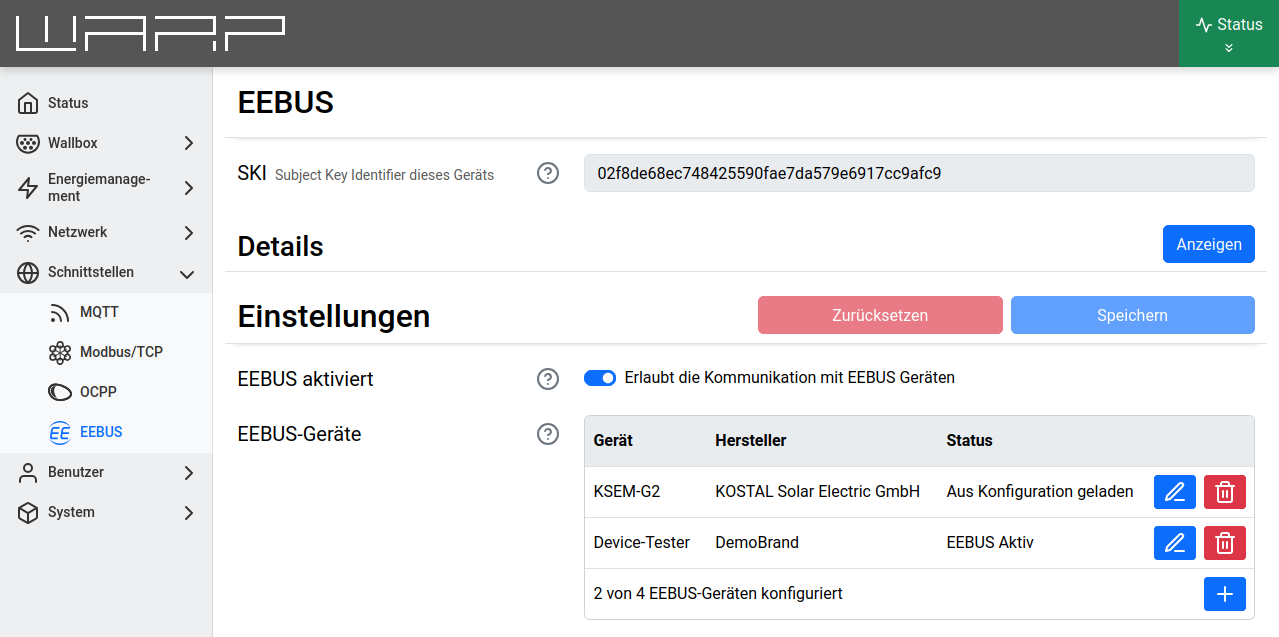
SKI (Subject Key Identifier)
The SKI is a unique cryptographic identifier for the device. If the device needs to communicate with e.g. a control box ("Steuerbox"), the SKI may be required during setup of the control box.
EEBUS enabled
Enables or disables EEBUS communication. EEBUS is disabled by default.
Details
The expandable Details section displays the current values of active use cases. The displayed values reflect the latest EEBUS communication data.
Adding devices (pairing)
EEBUS devices must mutually trust each other before they can communicate. Connections from unknown devices are rejected.
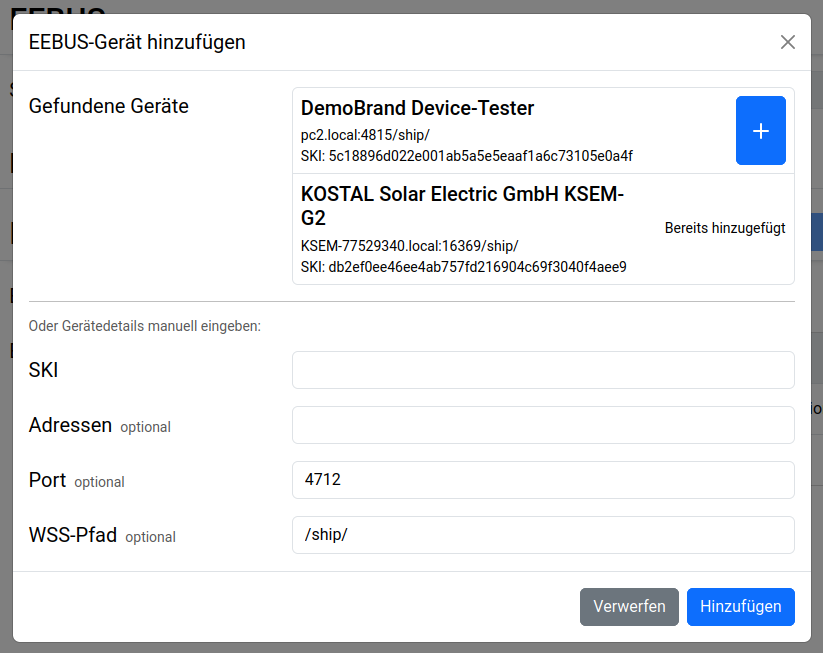
If a device is not automatically detected, it is possible to set the SKI and address/port/wss path manually. A device that was added is trusted by default.
Further information
- §14a EnWG — Central §14a EnWG control
- Controllable Consumption Device (Tutorial) — Overview of the various implementation options