ISO 15118
ISO 15118 is a communication standard between vehicle and charger that is handled over the charging cable via powerline communication (PLC) on the control pilot signal. The WARP4 charger has the hardware required for this. Through this communication, the charger can uniquely identify the vehicle and read out additional information such as the state of charge.
This page is used to configure the ISO 15118 functions. The upper area additionally shows status information about the ongoing communication, which mainly serves diagnostic purposes.
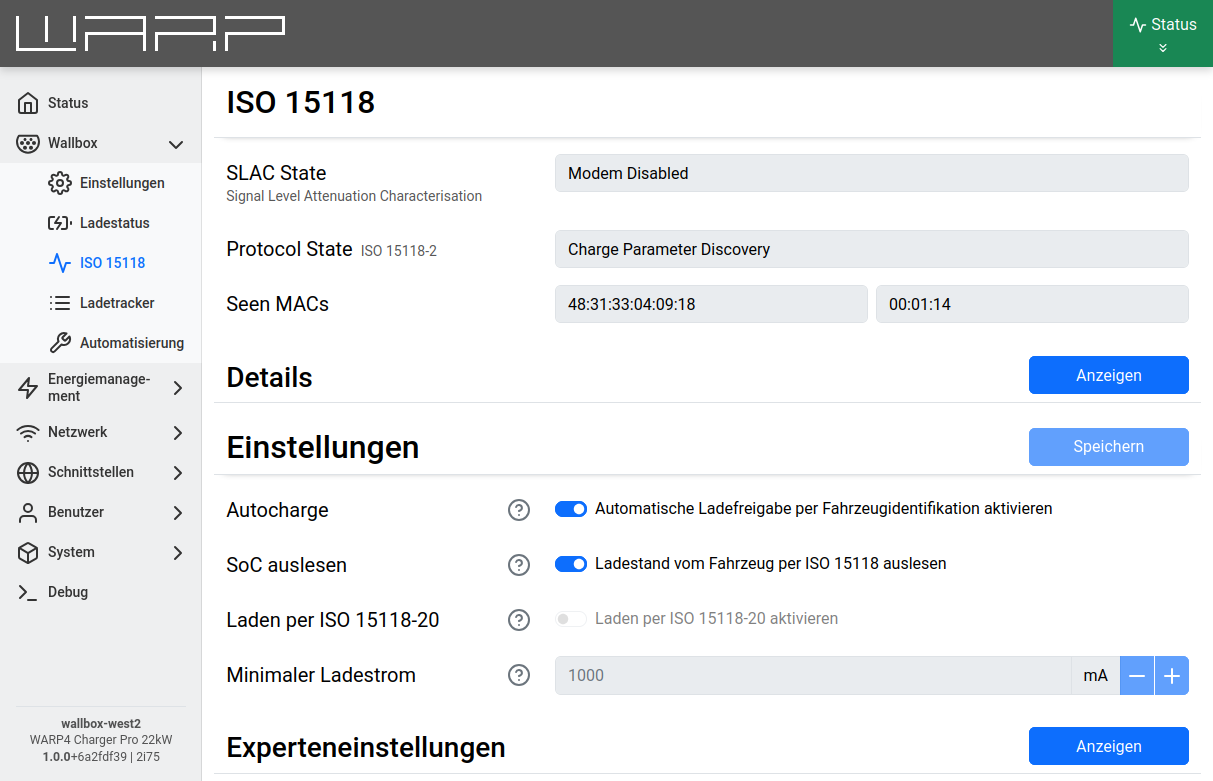
Configuration
Autocharge
Enables automatic charge authorization via vehicle identification. When Autocharge is active, the charger briefly communicates with a vehicle when it connects in order to read out its unique network identifier (MAC address). Depending on the vehicle, this takes about 5 to 20 seconds, after which the communication session is ended.
The MAC address that has been read out can then be used for charge authorization, analogous to an NFC tag. Which vehicles are detected and which user they are assigned to is configured on the Vehicles page.
Read SoC
When this option is enabled, the charger reads the current state of charge from the vehicle once via ISO 15118 at the beginning of a charging session. Depending on the vehicle, this takes about 10 to 45 seconds. After the first measurement, the state of charge is updated during charging using the built-in energy meter.
This function is only available on the WARP4 Charger Pro, since the built-in energy meter is required for it.
Charging via ISO 15118-20
This function is not yet available. It will be enabled with a future firmware update once the ISO 15118-20 certification has been completed.
With ISO 15118-20, the charger can identify the vehicle, read the state of charge continuously, and control the charging session directly via the ISO 15118-20 protocol.
Minimum charging current
The default minimum charging current that is offered to vehicles when charging via ISO 15118-20. Some vehicles can charge efficiently at low currents, while others waste energy doing so. If a vehicle charges inefficiently at low power, this value should be increased.
This setting will be enabled together with Charging via ISO 15118-20 at a later point in time.
Expert settings
In the expert settings, the Parameter Information Block (PIB) of the PLC modem can be managed. The PIB contains the configuration of the powerline modem.
- Download PIB: Downloads the PIB currently stored on the PLC modem as a file.
- Upload PIB: Transfers a PIB file to the PLC modem and flashes it. Afterwards, the modem is reset.
These functions are intended for diagnostic and service purposes only. An incorrect PIB can render the ISO 15118 communication unusable. These settings should only be used after consulting with support or for research/development purposes.
Status and diagnostics
The status area of the page shows information about the current ISO 15118 communication. This mainly serves for diagnostics, for example in case of problems with the vehicle communication.
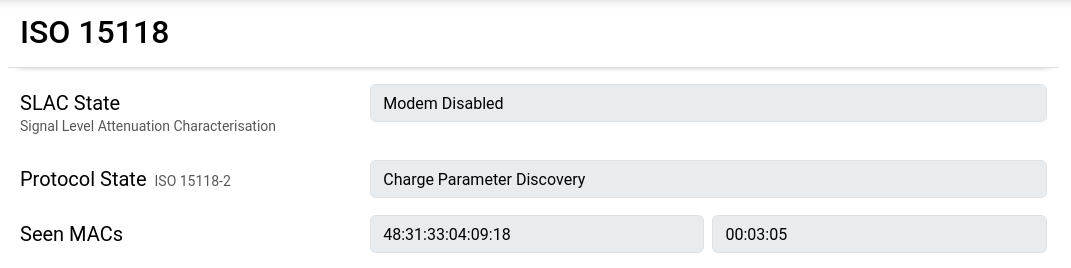
- SLAC State: The state of the Signal Level Attenuation Characterisation (SLAC), via which the matching modem in the charging cable is determined and the PLC connection is established.
- Protocol State: The state of the protocol currently in use (DIN 70121, ISO 15118-2, or ISO 15118-20).
- Seen MACs: The MAC addresses of connected vehicles most recently seen by the charger, including when they were last seen.
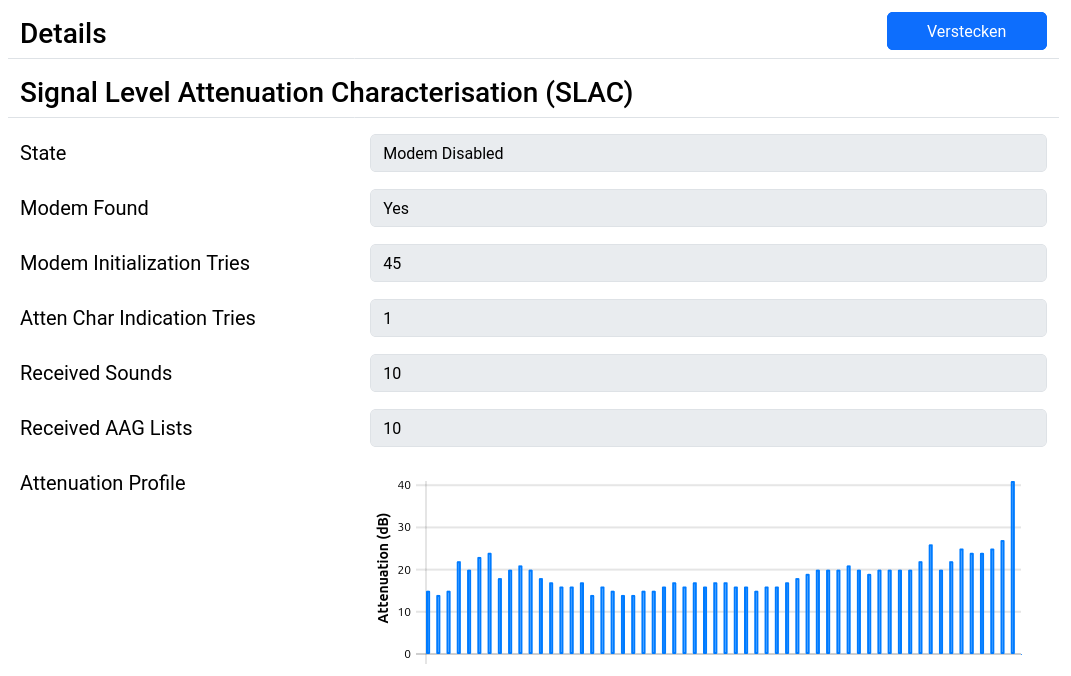
The expandable detail area provides further technical values about SLAC, the SECC Discovery Protocol (SDP), as well as the DIN 70121, ISO 15118-2, and ISO 15118-20 protocols (e.g. negotiated protocol, encryption, session ID, state of charge, battery capacity). These values are primarily relevant for troubleshooting by support.