PV Excess Charging
The configuration of PV excess charging is also described in the tutorial Photovoltaic Excess Charging.
The goal of photovoltaic excess charging is to charge an electric vehicle with the unused power from a photovoltaic system, rather than feeding it into the grid. The focus here is on maximizing self-consumption of solar power. This function can be performed by a WARP Charger or WARP Energy Manager.
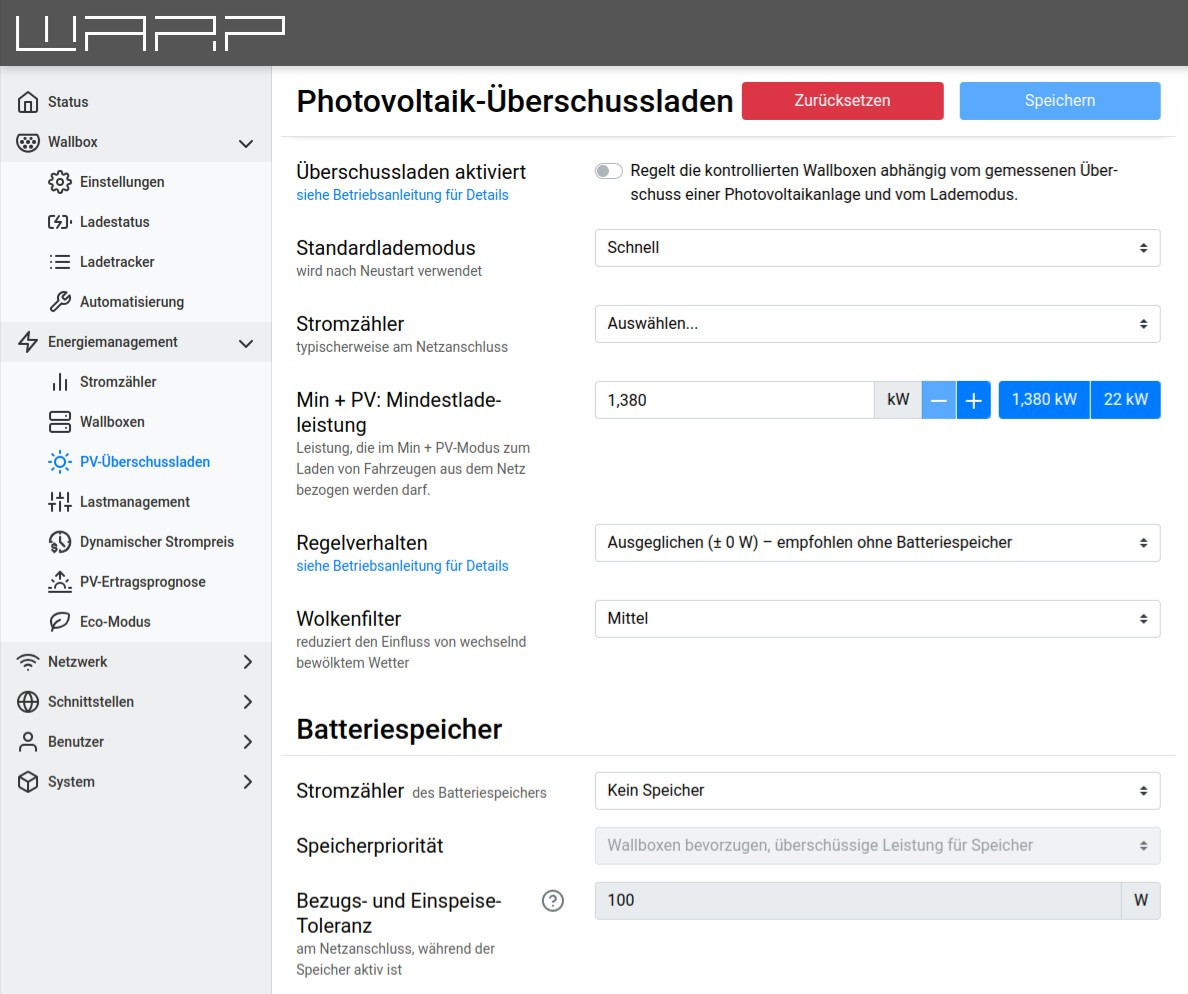
The following settings can be configured on this page:
- Excess charging enabled: Enables or disables the PV excess controller.
- Default charging mode: The charging mode that is used after a restart of the WARP3 Charger.
- Energy meter: The energy meter used to measure the PV excess. This energy meter must be created under Energy Meters.
- Min+PV: Minimum charging power: Specifies the power that may be drawn from the grid in Min+PV charging mode.
- Control behavior: Specifies the grid consumption target for regulation, for example to prioritize a battery storage higher or lower than vehicle charging.
- Cloud filter: Adjusts the inertia of the controller. In partly cloudy weather, it is useful for the controller to react sluggishly so that brief fluctuations in PV power are smoothed out.
If a battery storage system is present, it will regulate against the PV excess controller. If the battery storage can be read via an energy meter, the storage can be directly considered by the controller. For this, the following settings must be configured:
- Energy meter: The energy meter assigned to the battery storage
- Storage priority: Here you can configure whether chargers or storage are prioritized higher.
- Grid consumption and feed-in tolerance: The control target value for regulation.
Energy Meter Requirements
For PV excess charging to work correctly, the charger must continuously receive new data from the selected energy meter. The meter should provide updated readings at least every two seconds, ideally every second. If the meter does not provide any readings for approximately two minutes, the charging power is reduced to the minimum. After another four minutes, active PV charging processes are stopped.